
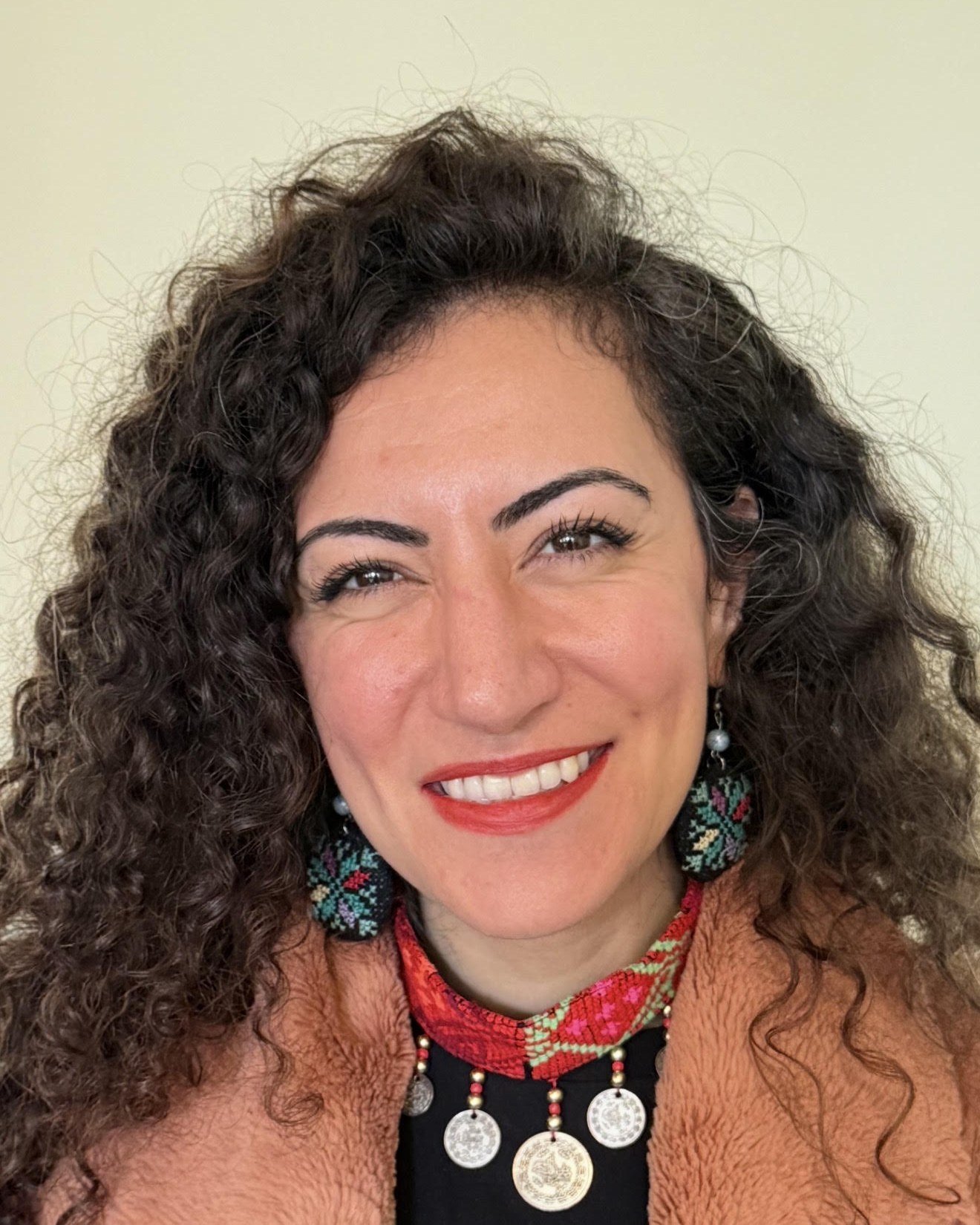
About Remah
Remah Naji is a linguist, university worker, unionist, and mother of two, living in Tarragindi on Brisbane’s southside, on Yuggera and Turrbal Country. She is one of Magandjin’s most consequential community organisers: someone who builds belonging from the ground up rather than waiting for it to find her.
She is Palestinian, and the daughter of refugees. She is the first Palestinian woman ever to stand as a candidate for the Australian Federal Parliament. And she is the woman who received death threats for daring to speak, and refused to stop. A Brisbane man was charged with threatening to kill her (ABC News, September 2025).
In July 2026 Remah became one of seven plaintiffs in Ismail v State of Queensland, a constitutional challenge now before the High Court of Australia.
The case contests the Queensland laws under which more than twenty people have been arrested for words spoken and worn at Palestine rallies. The plaintiffs argue those laws cannot stand against the freedom of political communication implied in the Australian Constitution. Whichever way it goes, it will settle something for everyone in this country who wants to speak in a public square
(Crikey, July 2026).
“This is about a genocide and our right to protest genocide, and to demand that this government uphold its obligation under international law.”
Remah will speak about the case on 23 August.
Remah’s story begins before her birth: in 1948, with the Nakba, the catastrophic displacement of the Palestinian people, and in 1967 with the Naksa, when a second wave of mass expulsion swept through the region. Her mother was born in Jordan because her family had already been forced from their homeland; her father survived the 1967 displacement as a child.
Remah herself was born in Amman and raised there, growing up Palestinian among Palestinian refugees: Jordanian by birthplace, Palestinian by heritage and by her own account of herself. The family she comes from were exiled from Yaffah, on the coast of Palestine.
This history sits at the dinner table. It is the bedtime story. It is the inheritance she brings into every room she enters, including this one.
“All of our conversations at the dinner table were about the injustices happening in the world,” she remembers of her childhood. “This is messed up and I want to fight for you.”
The Nakba and the Naksa: how Remah’s family became refugees
Before the war reached it, Yaffa, known in English as Jaffa, was the largest and richest Arab city in Palestine: a port town of orange groves, printing presses and seafront cafés, home to some 70,000 people. Its own residents called it Arus Filastin, the Bride of Palestine. In three weeks of April and May 1948, under bombardment and siege, nearly all of them fled; barely 4,000 remained when the city surrendered on 13 May 1948. Remah’s family was among the tens of thousands driven out.
Her mother was born stateless in Jordan because her family had already been forced from Yaffa. Her father was a child in June 1967 when a second war displaced around 300,000 more Palestinians, close to half of them refugees for the second time. Her parents met in Amman as refugees from two catastrophes nineteen years apart, and built a family in exile.
Yaffa, Apr–May 1948
~70,000 → ~4,000
Residents before the war, and remaining at the surrender of 13 May 1948.
The Nakba, 1947–49
700,000+
Palestinians displaced nationwide, from more than 400 towns and villages.
The Naksa, June 1967
~300,000
Displaced when Israel occupied the West Bank, East Jerusalem and Gaza.
Twelve years ago, Remah moved to Australia, arriving in a city where she knew no one. She did not wait.
She volunteered, showed up, and organised, embedding herself in communities living with migration, housing insecurity, disability, and systemic exclusion, long before anyone asked her to run for parliament, and long before she had a profile or a following. She showed up because injustice required it.
Today she is the spokesperson for Justice for Palestine Magandjin, a movement she helped build into one of the most active Palestine solidarity campaigns in Australia. She has organised mass rallies, chaired public forums, and amplified voices in the streets of Brisbane.
In 2025, Queensland counter-terrorism police arrested a man who had twice threatened to kill her for her advocacy. She then showed up at the next rally.
“Until your land is back, we will stand with you.” Speaking to the Hayes family, Traditional Owners fighting to reclaim the land occupied by the Pine Gap military base, Remah said she would be guided by First Nations people, “because I would also like my land back… and I would also like freedom for the Palestinian people.”
For Remah, Palestinian liberation and First Nations sovereignty are one struggle: for return, for land, for self-determination.
In 2025, Remah stood as the Greens candidate for the federal seat of Moreton, Queensland’s most linguistically and culturally diverse electorate, renouncing her Jordanian citizenship to do so. She ran as a movement spokesperson refusing to disappear.
Those who know Remah describe something beyond her politics. At a campaign fundraiser, a supporter remembered watching her bend down to eye level with a child, and thinking: this woman is fully present with everyone she meets.
She describes herself simply and honestly: linguist, mum, social justice campaigner, proud Palestinian, curly hair enthusiast. Asked what gives her hope, she does not gesture toward policy or process. She says: “The streets give me hope. The people who show up, rain, hail or shine, to stand in solidarity with the oppressed.”

Source: Remah Naji, “Q&A: Meet Your Muslim Greens Candidates!”, published on her official campaign site Remah for Moreton (8 October 2024).
Uncle Bill’s Yarning Circles exist for connection. They bring accomplished First Nations people, and friends who walk beside them, into the circle to share the arc of their own story, personal, professional, and public, so that non-Indigenous members of the community can know them person to person, beyond the causes and the headlines. Remah brings exactly such a story, gathered from protest lines, kitchen tables, community meetings, and the streets of Magandjin.
She comes to this Yarning Circle with the memory of dispossession in her bloodline, and she has chosen to spend that inheritance speaking, with full voice, for the sovereignty and dignity of every people the system was designed to silence.
Remah joins Uncle Bill Lemson at St John’s Cathedral on Sunday 23 August 2026 to share a story of displacement, belonging, and building community from the ground up. Everyone is welcome.
Sources: Biographical material compiled from Remah’s public writing and advocacy. Photos by Philippe, used with Remah’s permission. Follow Remah at @thisisremahnaji on Instagram.
Take the flyer with you
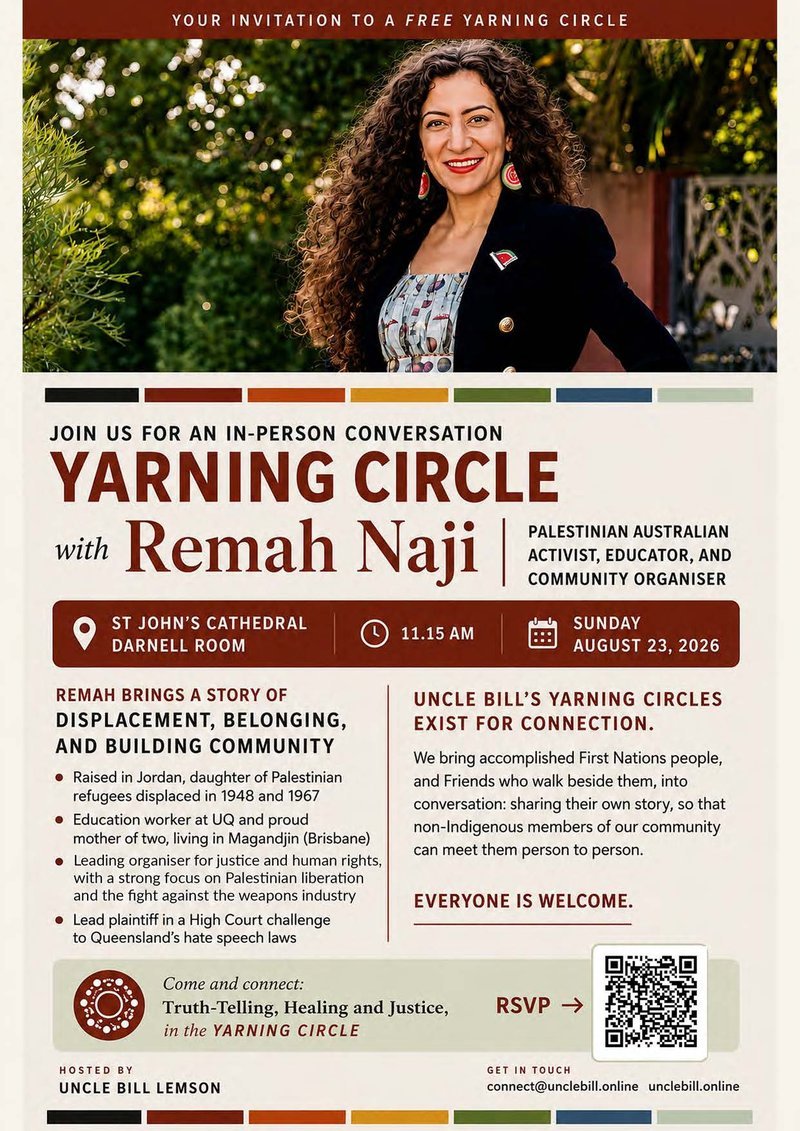
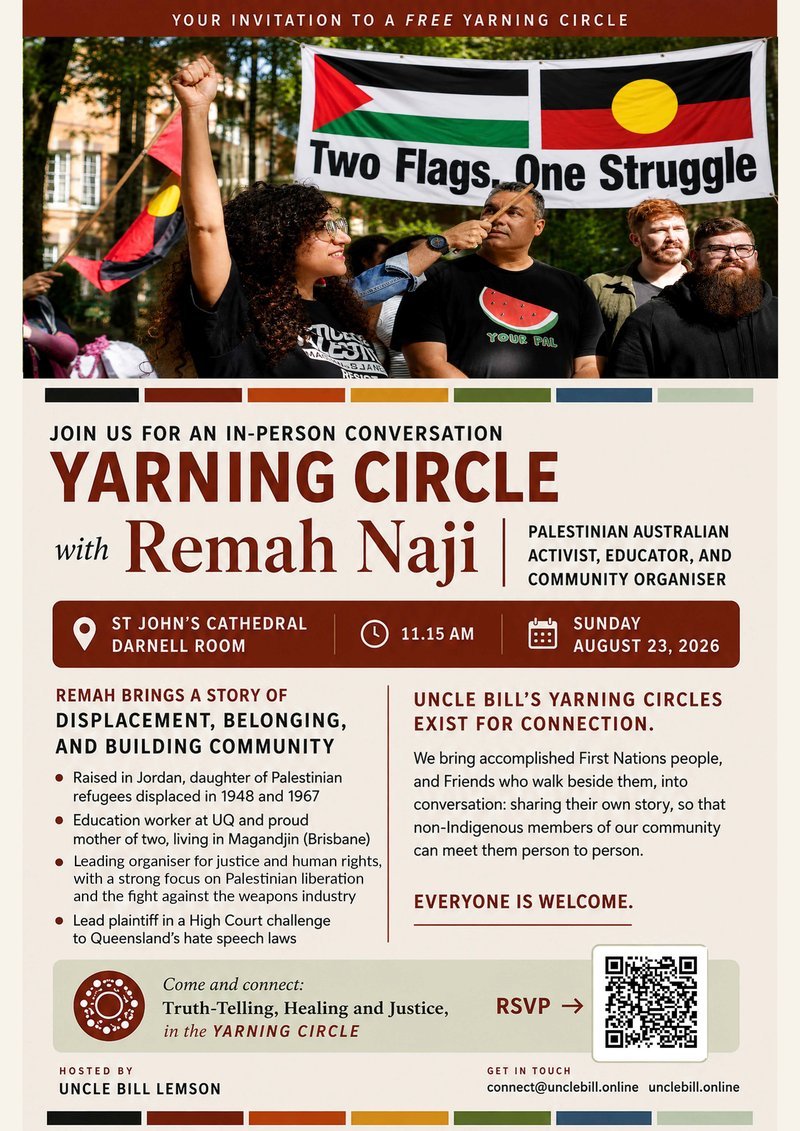
23 August Yarning Circle with Remah Naji
A quick RSVP helps me prepare seating and tea for the right number of people.
I’ll send you a confirmation email once you’ve replied.
Uncle Bill Lemson
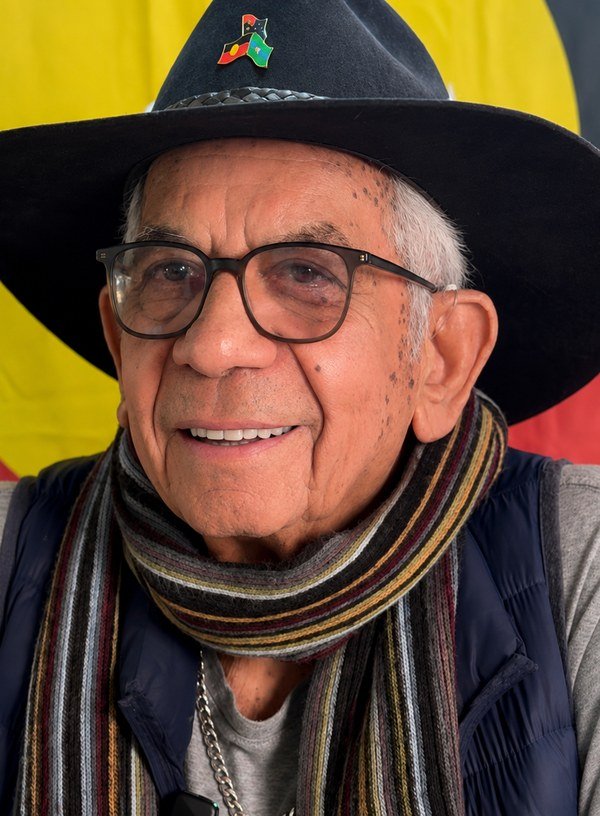
on the day
Sunday 23 August 2026
11.00 AM arrival
for an 11.15 AM start
Darnell Room, St John’s Cathedral
373 Ann Street, Brisbane
Morning tea afterwards. Bring a plate to share if you would like to — and if it is just yourself, that is exactly right too.
— Uncle Bill Lemson
+ Add to my calendar Google Calendar