
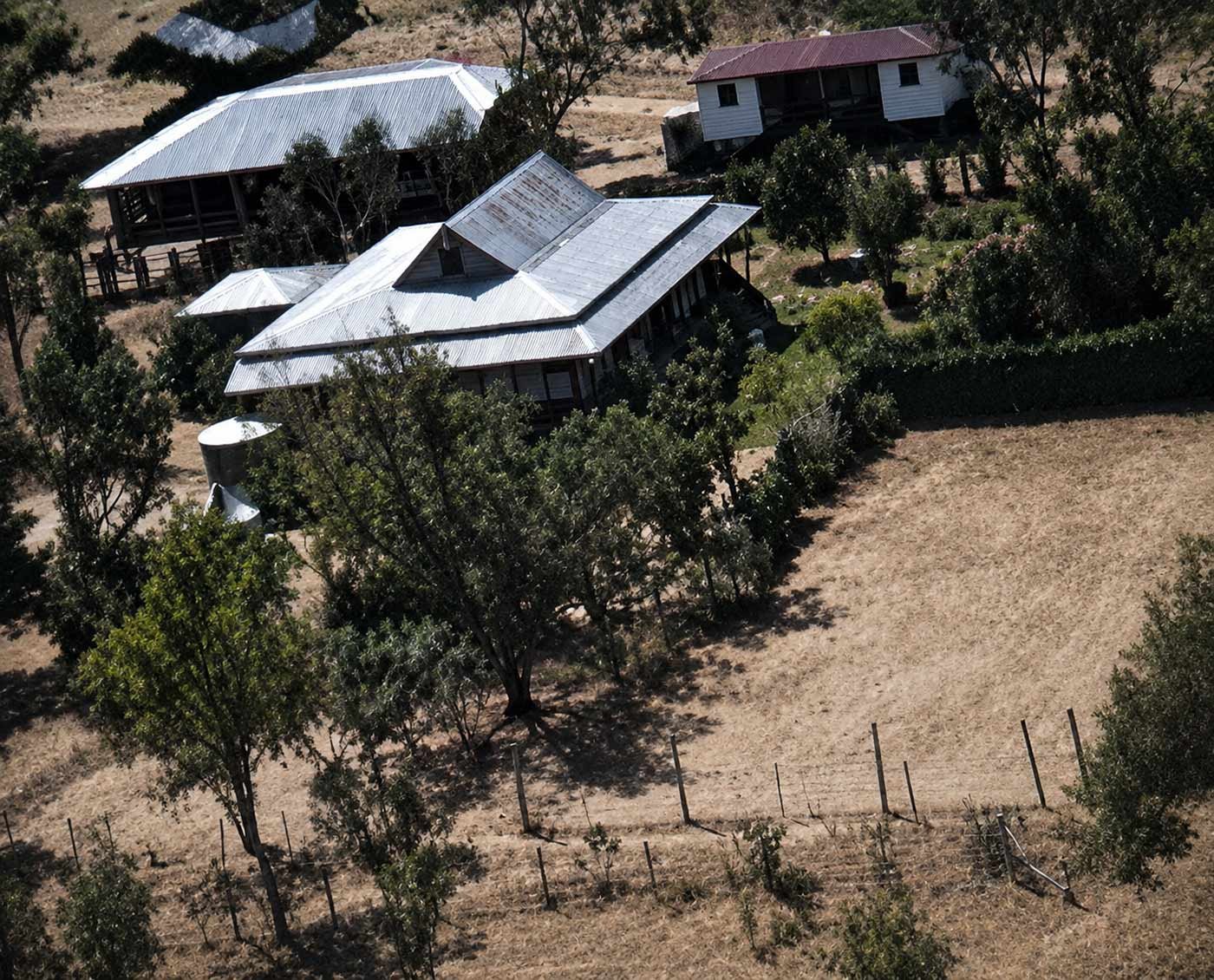
Almost nothing about any one Aboriginal family on a Gulf station was written down in a place anyone can search. Station employee names sat in government protectorate files and in the stations’ own private ledgers. What was written down, and written down plainly, is the world of those families’ working lives. That record is set out below, so a reader knows what it meant to work at a place like Lorraine.
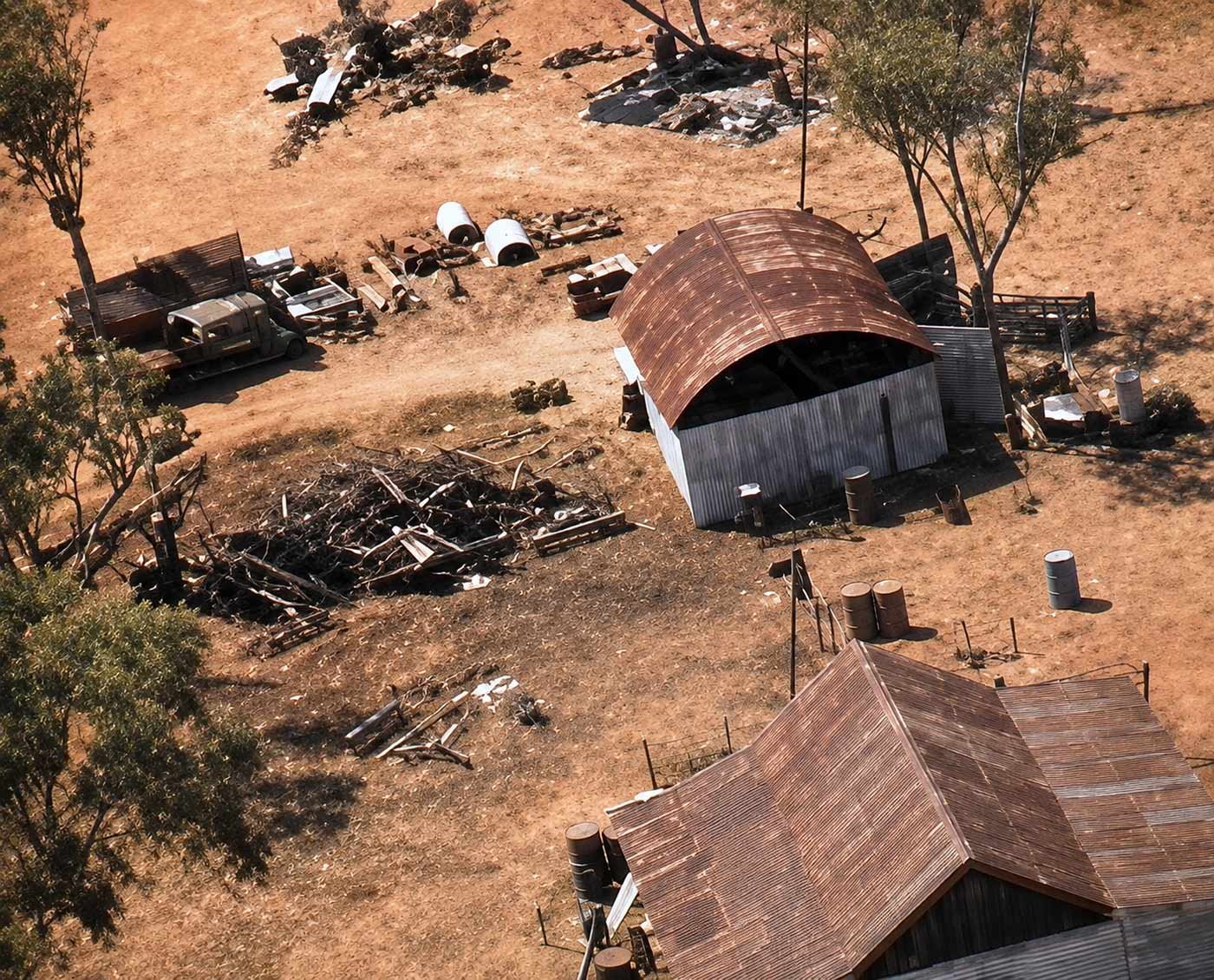 The station complex from the air, 1952 Sheds, yards and working gear on the flat above the river, from the same Hoole flight. State Library of Queensland, 27318/12.
Lorraine Station sits on the Leichhardt River between Cloncurry and the Gulf of Carpentaria, in Queensland’s Gulf Country. The property runs to around 240,000 hectares, between the Burke and Wills Roadhouse and Burketown, and its lease crosses the Burke, Carpentaria and Cloncurry shires.
The Traditional Owners of the Cloncurry country are the Mitakoodi, the River People, alongside the Kalkadoon, Yulluna, Pitta Pitta, Bularnu, Waluwarra and Wangkayujuru peoples. The Burke Shire portion of Lorraine’s lease sits on Gangalidda Garawa and Waanyi country. Burketown itself lies within that same reach, so families of the district and the station were not separate worlds.
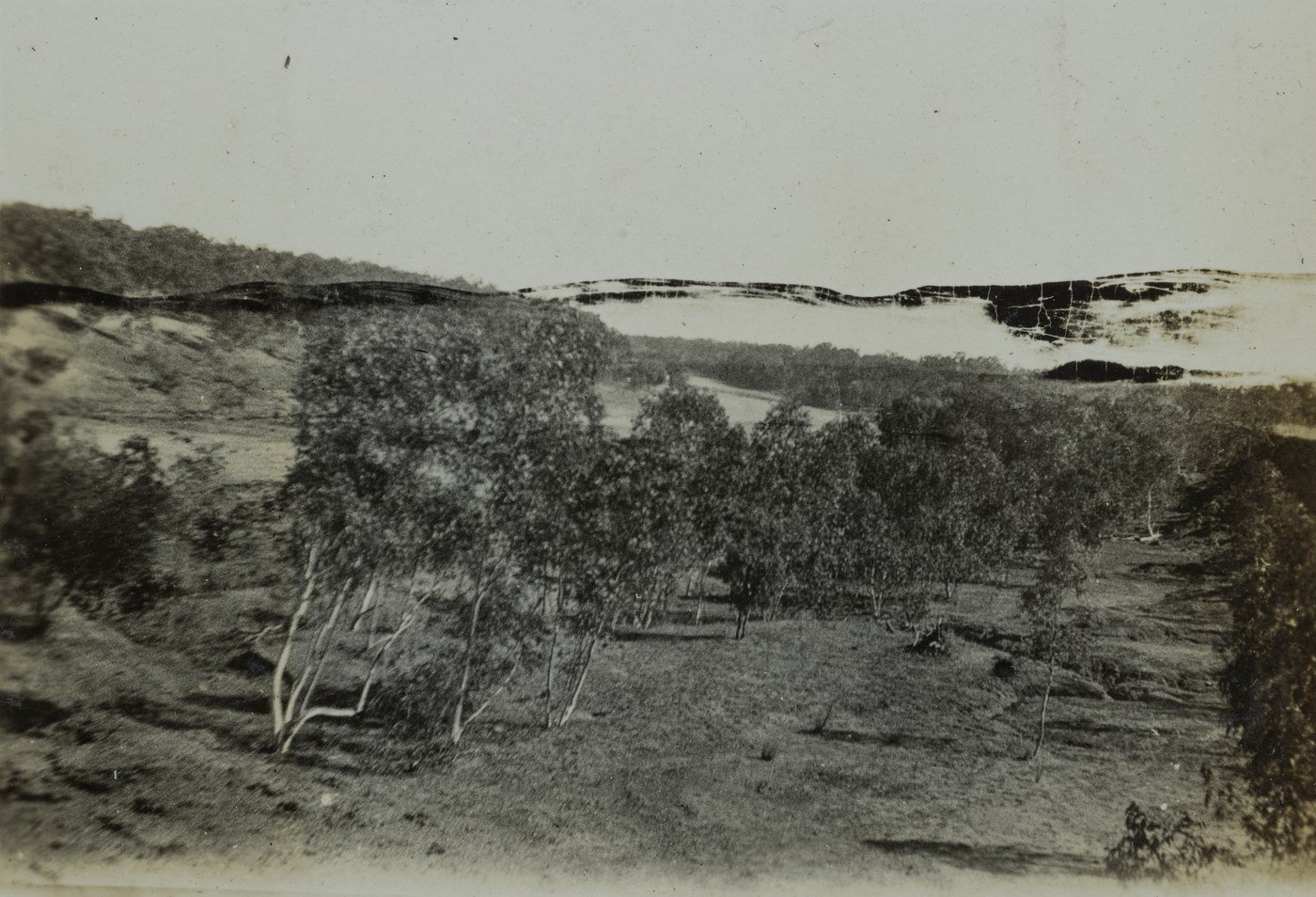
The station was first taken up in 1877 by the Brodie brothers, and Frederick Arthur Brodie ran it himself after prospecting the district. A travelogue kept by the Curr family that same year describes Brodie’s station at Lorraine, some sixty miles above Floraville on the Leichhardt, and the Brodies as exceedingly hospitable. In 1915 it was formalised as the Lorraine Pastoral Company by Brodie, Sir Sidney Kidman, and the brothers Frank and James White. Descendants of those families own the station today.
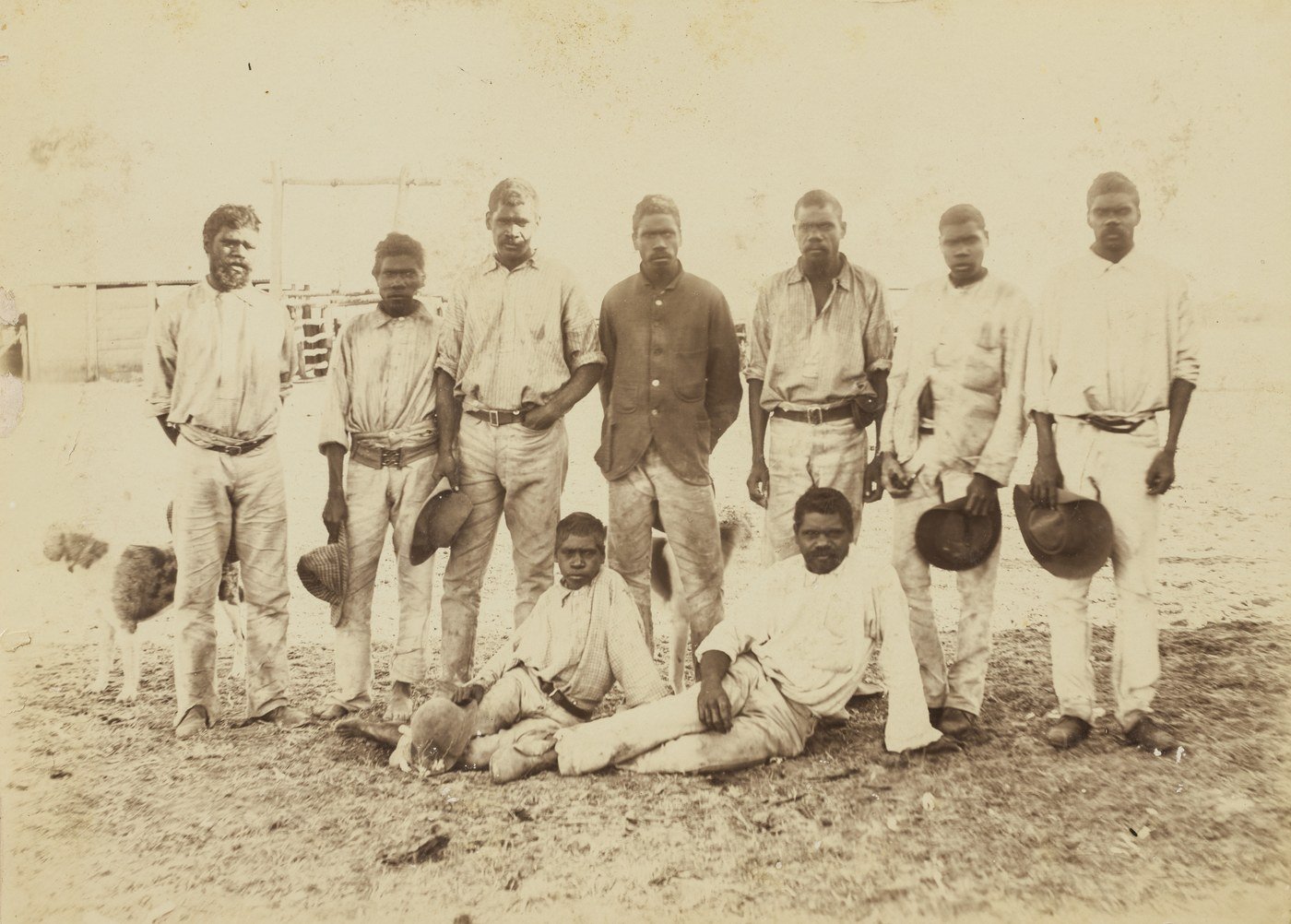 Aboriginal stockmen at Canobie Station, 1895 Canobie sits on the Cloncurry River in the same Gulf Country as Lorraine. Photographed for the Royal Geographical Society of Queensland. State Library of Queensland, API-87-0001-0043.
This is the fact that matters most, and it is not a small one. In 1936, ninety per cent of stations in the Cloncurry district were worked by Aboriginal stockmen. Station owners preferred them to white labour, on the record, because they were better stockmen and more reliable.
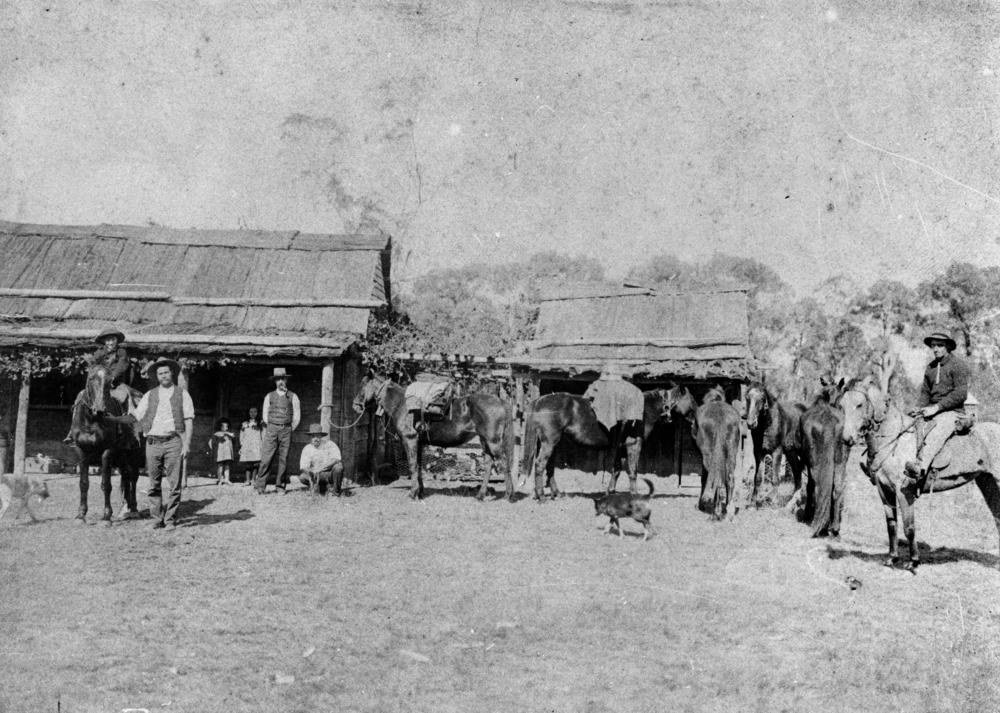
That was not a local anomaly. Queensland’s pastoral workforce was already more than forty per cent Aboriginal by 1876 and fifty-five per cent by 1886. The historian Ann McGrath describes Aboriginal workers as the backbone of the cattle industry, building it up from nothing. By 1904 Gulf stations generally were run almost entirely on Aboriginal labour. Across most of the twentieth century, between three thousand and six thousand Aboriginal men, women and children were employed in the Queensland pastoral industry, and until 1968 that workforce was almost entirely controlled by the state.
Pastoralists in the north west had begun employing Kalkadoon and other Aboriginal people on stations by the late 1880s, and Aboriginal stockmen have worked the North West Queensland cattle industry ever since.
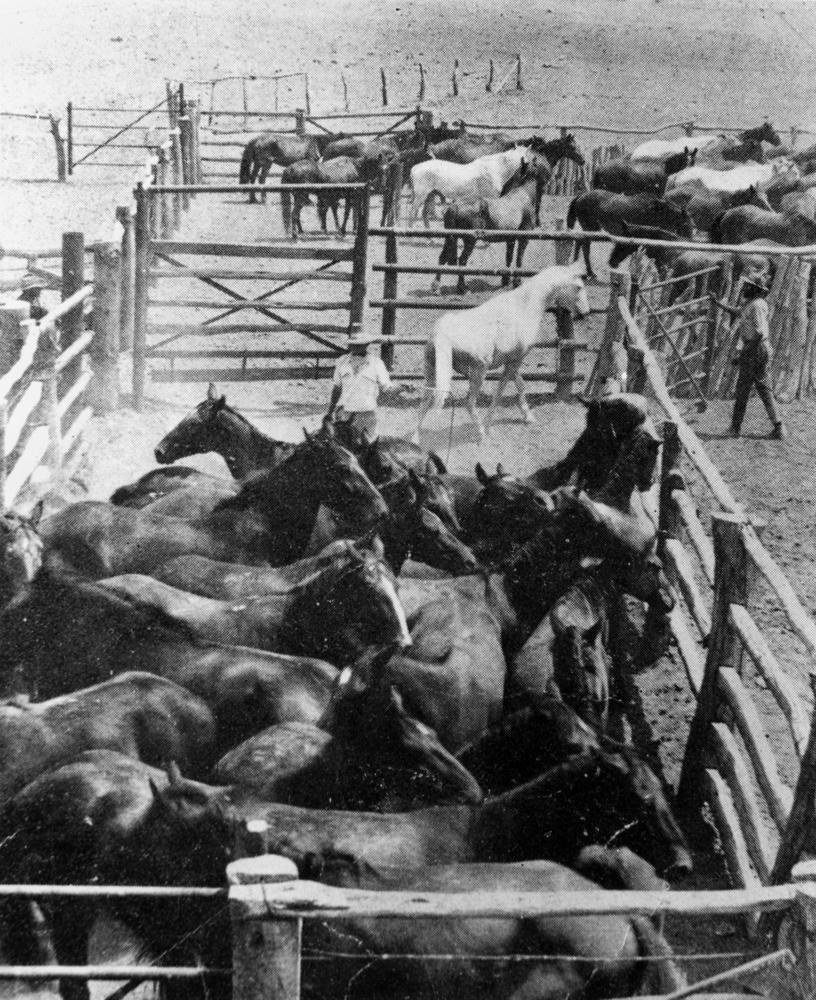 Drafting horses at Avon Downs Station, near Camooweal Yard work of this kind filled the station calendar. State Library of Queensland.
Boys started young. Ian Saltmere, raised on Rocklands Station near Camooweal, was a full-time drover at thirteen, having grown up listening to droving stories from the older Aboriginal stockmen. Fred Edwards of Normanton began station work at twelve.
The skills passed down inside families and inside the stock camp. Sons learned horsemanship and stock work from fathers, uncles and older stockmen. There was no school for it.
The work available to Aboriginal men and boys covered stock work and mustering, droving, horse breaking, yard work and fencing, and camp cooking. Women and girls were put to domestic work in the station house.
Families commonly lived and worked at the station for nine or ten months of the year, with the wet season, roughly three months, as a return to country for family and ceremony.
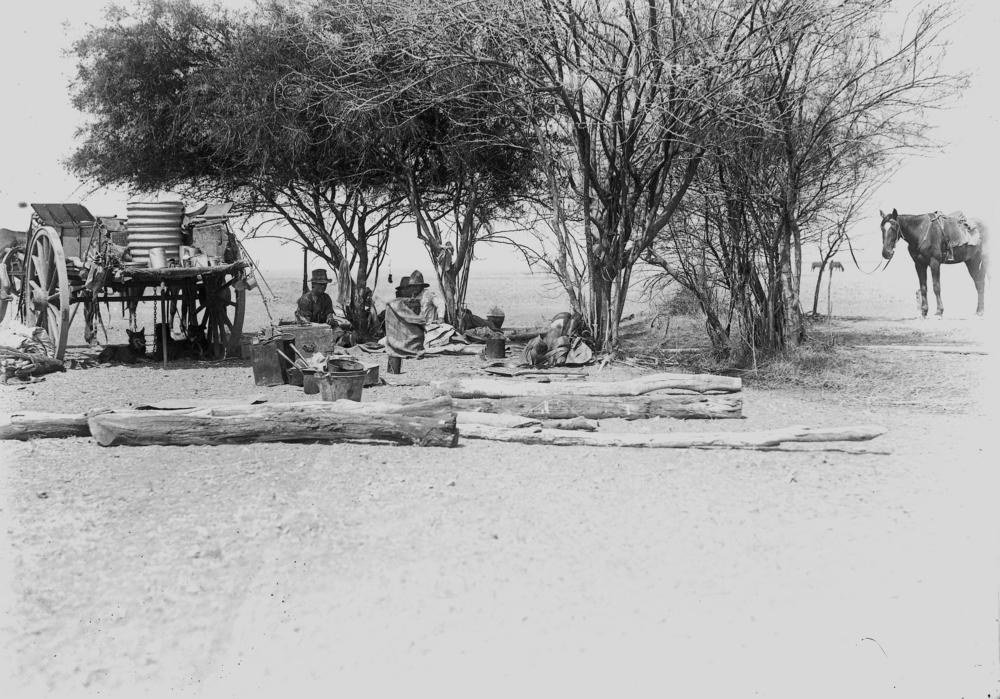 A drovers’ camp near Hughenden, around 1916 On the runs day and night, a day’s work nearer sixteen hours than eight. State Library of Queensland.
A government report on the Cloncurry region in 1936 found that Aboriginal stock workers worked long hours and often had no Sundays. While mustering they were out on the runs day and night, and a day’s work was nearer sixteen hours than eight. The wages amounted to a bare existence for a married man.
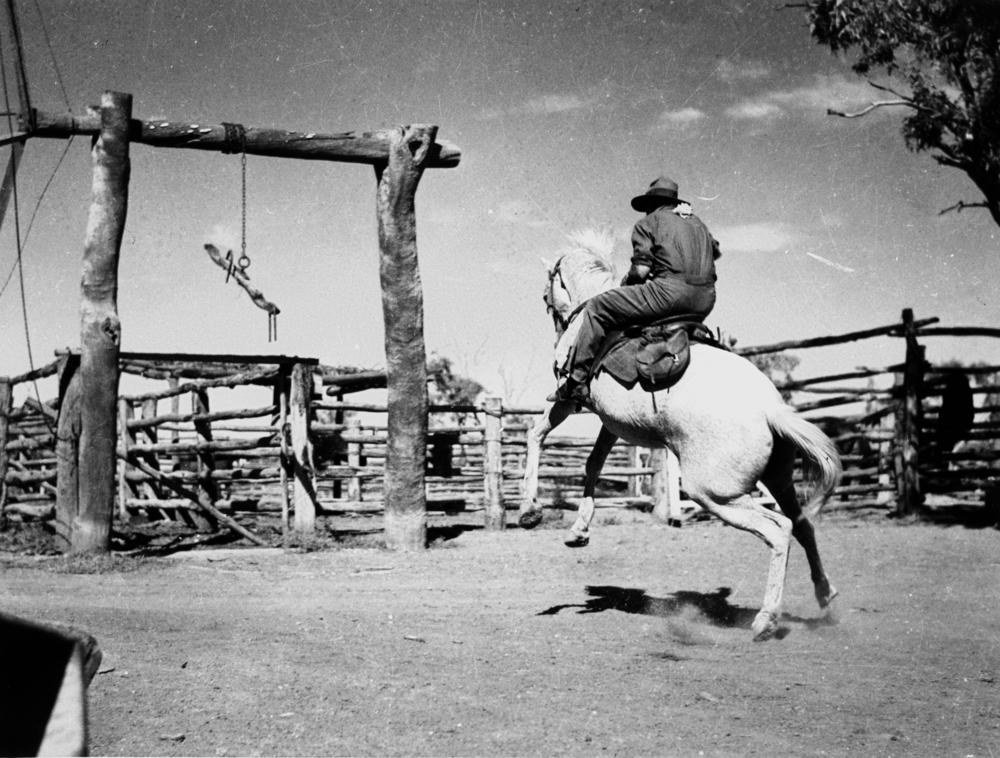
The Protector at Normanton described the standard Gulf station routine plainly. The Aboriginal stockman was last to bed and first up. He made the fire, carried the water, and attended the white men. It was the general rule that he rode the highest spirited horses before the white stockman would condescend to ride them.
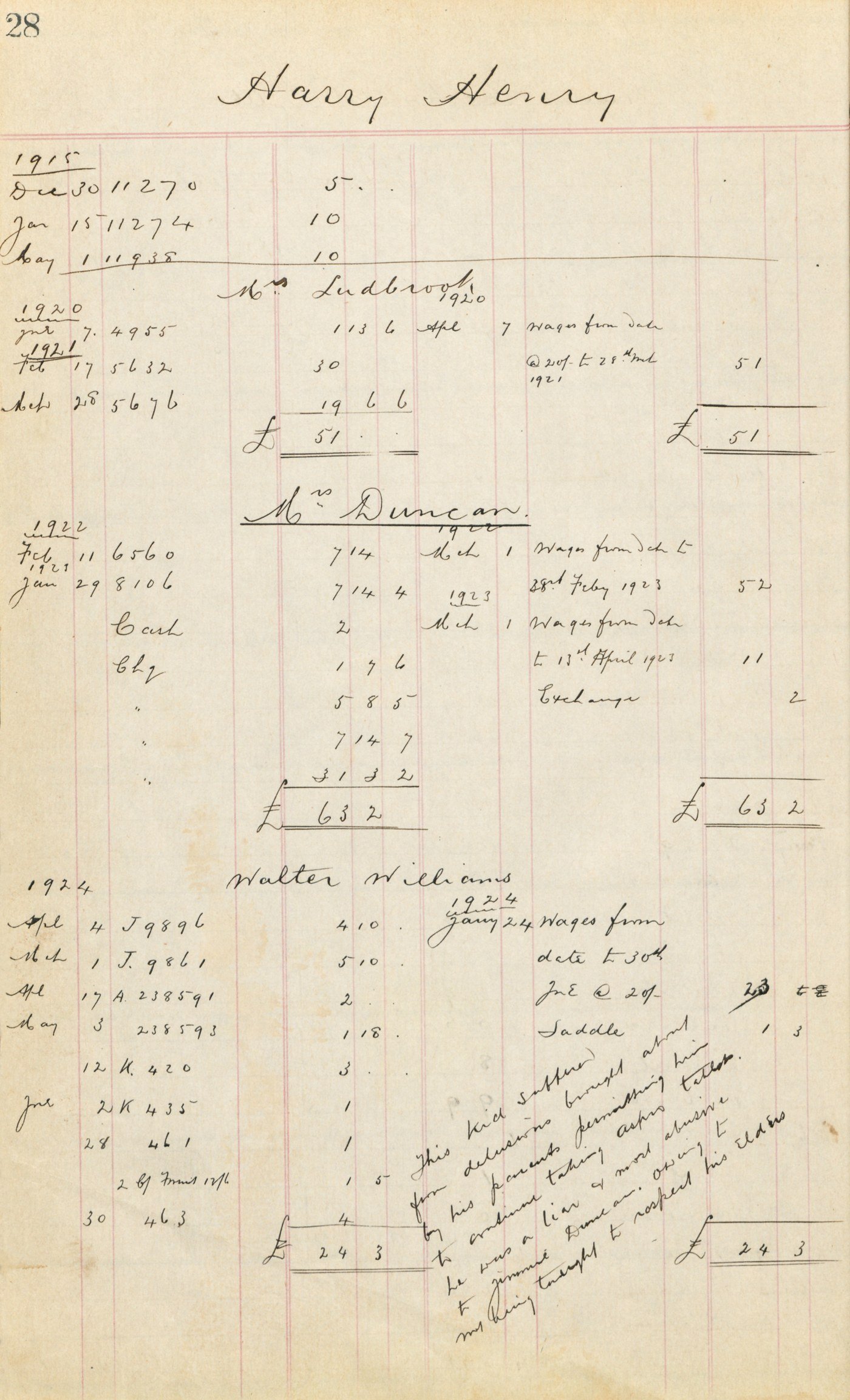 The wage account of Harry Henry, Forest Vale Station, 1915 to 1924 An employer’s record of wages, cash and goods from the Lethbridge family’s Forest Vale ledger. The government control of Aboriginal wages and savings ran through separate books; this folio shows the day-to-day accounting of a working life. State Library of Queensland, OM84-16/21.
Under the Aboriginals Protection and Restriction of the Sale of Opium Act 1897 and the laws that followed it, the Queensland government controlled the wages and the savings of Aboriginal workers. Wages came partly as rations and tobacco, with a small discretionary allowance called pocket money. The state held the rest.
The official Aboriginal pastoral wage was set at sixty-six per cent of the white rate in 1919. By 1938 and 1939 it had fallen to forty-one per cent. In the early 1930s, when white rural labour was being described in official files as often useless and Aboriginal labour as indispensable, four and a half thousand Aboriginal workers in Queensland were hired out at about forty per cent of the award rate, and that continued for more than a decade.
The pocket money was not secured. An internal inquiry in 1932 concluded it could reasonably be assumed that workers were not receiving it. In 1943 protectors called the whole system a farce and a direct profit to employers. In 1956 they described it as useless, futile and out of control, with workers entirely at the mercy of employers who simply doctored the books.
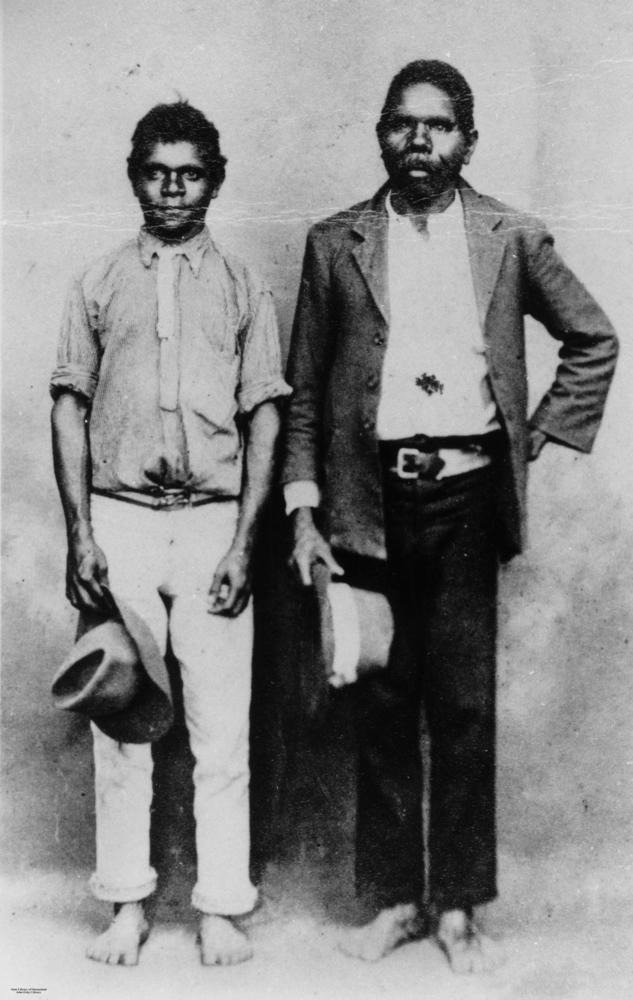 Digby Denham and Old Mango, Aboriginal stockmen, 1916 Photographed at Midgenoo in far north Queensland, where they worked stock for William Dallacy. Both men stand barefoot for the portrait. Men like these built the industry that paid them a fraction of the award. State Library of Queensland.
The Commonwealth Conciliation and Arbitration Commission handed down its equal pay judgment for the cattle industry in 1966, and the ruling came into force in 1968. When the case was heard, the Commission accepted evidence from employers that many of them expected to change over to white labour if Aboriginal workers had to be paid award rates. Across northern Australia that is broadly what happened. Stations cut their Aboriginal workforce and evicted families who had lived on them for generations, and Gulf families remember it as the most destructive period in living memory.
Queensland did not simply follow the national timeline, and the difference matters. The state defied the 1966 judgment. Workers still under state control were relabelled trainees and continued to be hired out at a discount, whatever their decades of skill, under a slow worker clause that allowed full wages to be phased in over time. It was only after 1972 that Aboriginal workers in Queensland were free to choose their employment and demand a legal wage, and 1972 before they could even request permission to control their own bank accounts.
A closing reflection
Many First Nations families of this district know only part of their own story. That is the designed result of a system that kept the records of Aboriginal working lives in protectorate files and station ledgers rather than in anything a family could hold, and that controlled where people could go, what they could be paid, and whether they could keep it.
What can be recovered is the shape of the world. A boy at Lorraine in those decades was in a place where nearly everyone doing the stock work was Aboriginal, where the skills came from his father and the older men in the camp rather than from a school, and where the pay for that work was set by a government that was not paying it in full. That is the world in which a boy came to love horses.
Sources and further reading
- Dr Rosalind Kidd — Unpaid Wages to Indigenous Pastoral Workers
- Dr Rosalind Kidd — Aboriginal Workers, Aboriginal Poverty
- Dr Rosalind Kidd — Stolen Wages Fact Sheet
- National Museum of Australia — A financial scandal
- Indigenous Rights Australia — Equal wages, 1963 to 1966
- Queensland Government — Mount Isa community history
- State Library of Queensland — Working Country
- State Library of Queensland — Aboriginal stockwomen, hidden figures of Australia’s pastoral industry
- James Cook University Library Special Collections — Lorraine Station records
- Lorraine Pastoral Company — Our Story
- Obituaries Australia — Frederick Arthur Brodie
- Burke Shire Council — Our Region history
- ANU Press — Station camps